My artwork has always emerged from a sustained engagement with systems: systems of order, systems of value, systems of memory, systems of belief, and systems of selfhood. Yet these systems rarely appear in my work as stable, rational structures. More often, they are placed under pressure, made to repeat themselves, contradict themselves, or reveal the absurdity hidden inside their own logic. Across sculpture, installation, performance, digital imaging, 3D modeling, bronze casting, and virtual exhibition, my practice returns again and again to a central question: what remains when meaning is stripped away, deferred, randomized, emptied, or reassembled?
The answer has changed over time. In the earliest works, nothingness appeared through the lens of existential absurdity: the pointless task, the futile gesture, the machine condemned to repeat, the viewer trapped in a ritual of waiting. Later, that same nothingness became more expansive, moving from negation toward possibility. Through Zen practice, meditation, and a deepening interest in sacred space, absence became less a symbol of futility than an opening: a zero point from which meaning might emerge. Between these two poles—the absurd void and the generative void—my work has unfolded.
The Absurd as Structure
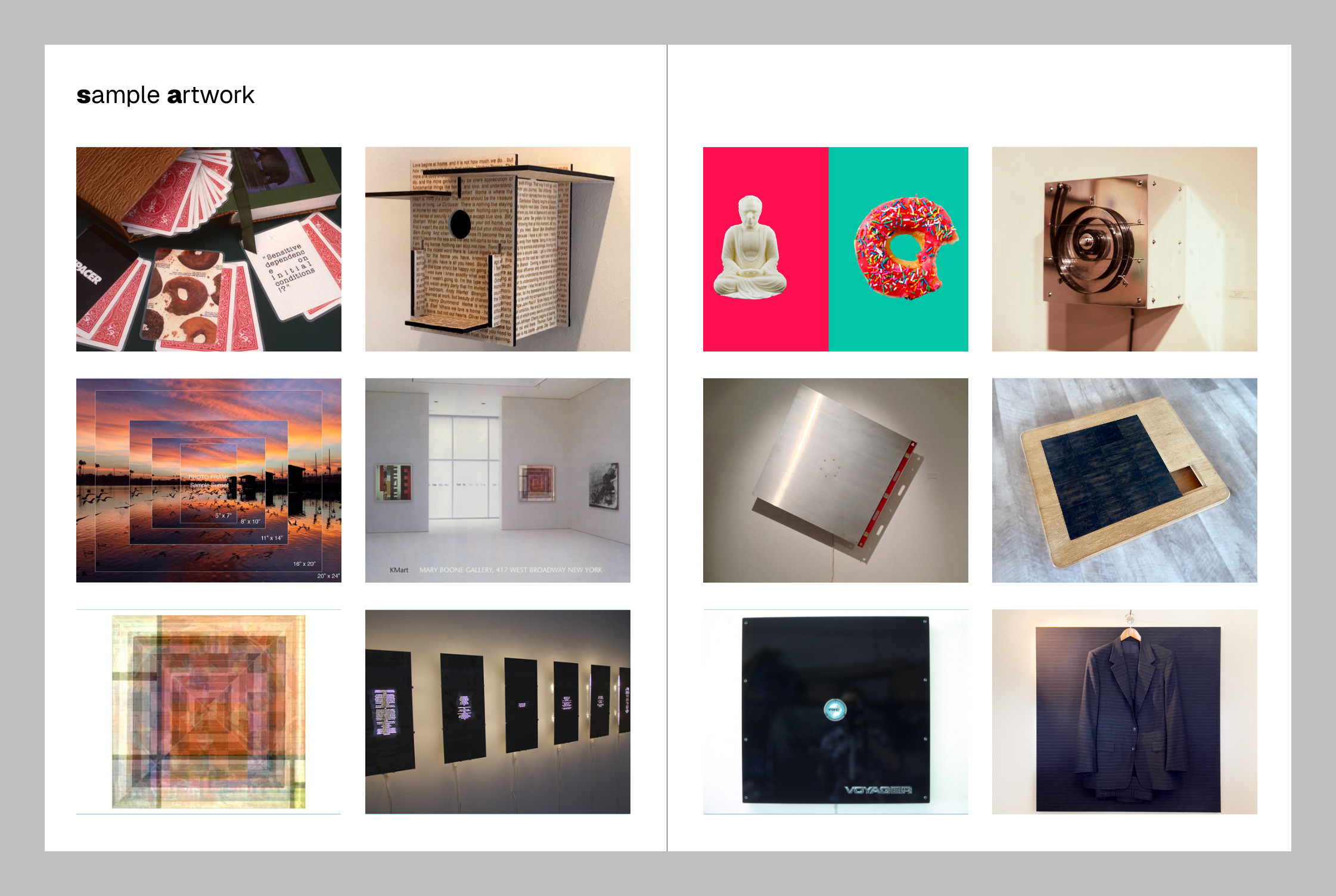
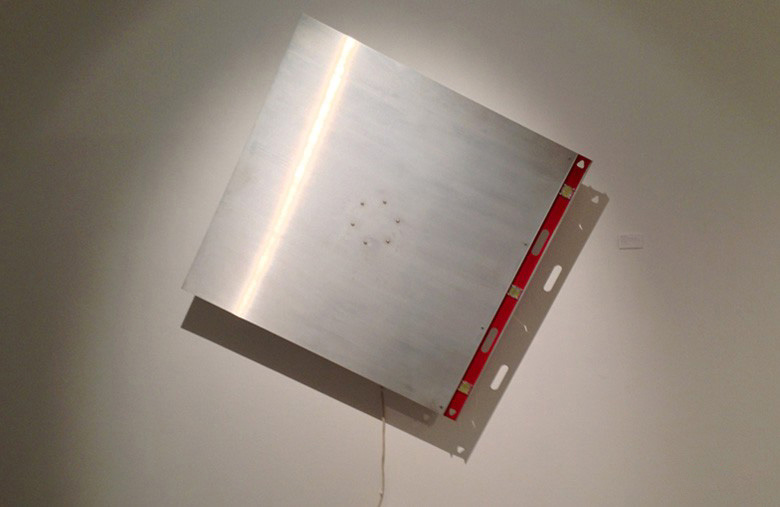
One of the earliest and most important works in this trajectory is The Square That Rotates, created while I was working on my M.F.A. At the time, I was deeply influenced by the Theatre of the Absurd, particularly the plays of Eugène Ionesco and Samuel Beckett. The work is deceptively simple: a square piece of aluminum with a spirit level attached to one side, rotating once each hour. Its function is both clear and ridiculous. A spirit level is designed to measure balance, but here it is attached to an object whose movement guarantees perpetual imbalance. The piece performs purpose while defeating it.
This work introduced a condition that would recur throughout my practice: motion without meaningful progress. Something happens, but nothing develops. A square turns; a level registers; time passes. Yet the system arrives nowhere. I later came to think of this condition as the “development of non-development,” a state in which action is continuous but transformation is illusory.
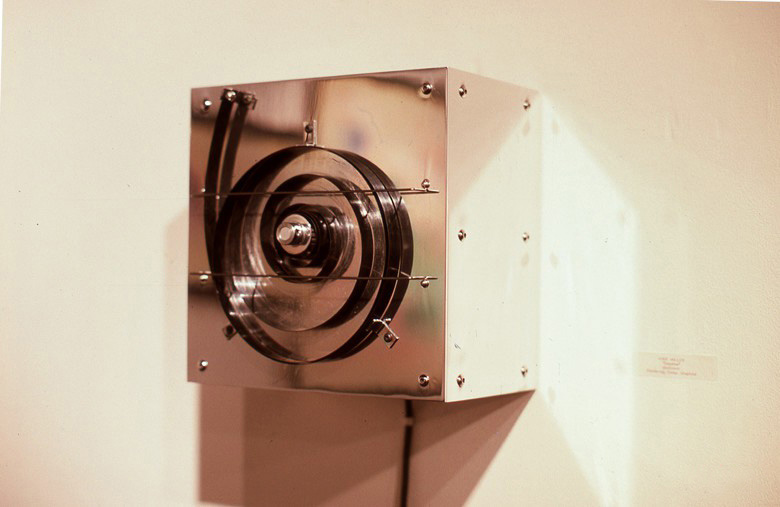
Sisyphus extends this logic into kinetic sculpture. Named after the mythological figure condemned to roll a boulder uphill for eternity, the piece consists of an aluminum box containing a small motor that winds a spring until it snaps loudly, then begins again. The machine performs a task that has no practical purpose and no final resolution. It is both comic and maddening, a small theater of futility. Like Camus’ Sisyphus, the work occupies the space between despair and defiance. Its repetition acknowledges the absurdity of existence, but its theatricality keeps it from collapsing into nihilism. The snap of the spring becomes a punchline as much as a punishment.
30 Balls Moved 30 Times shifts the absurd system from machine to artist. During the exhibition, I clocked in with a time card, arbitrarily moved thirty balls in the gallery, and clocked out. The work imposed a ritual of labor upon me, but the labor produced no meaningful advancement. The balls moved, the gallery changed, yet nothing essential occurred. Unlike Sisyphus, which functioned as an autonomous closed system, 30 Balls Moved 30 Times made me subject to the artwork’s demands. The piece became a bureaucratic parody of productivity, a performance of work emptied of use.
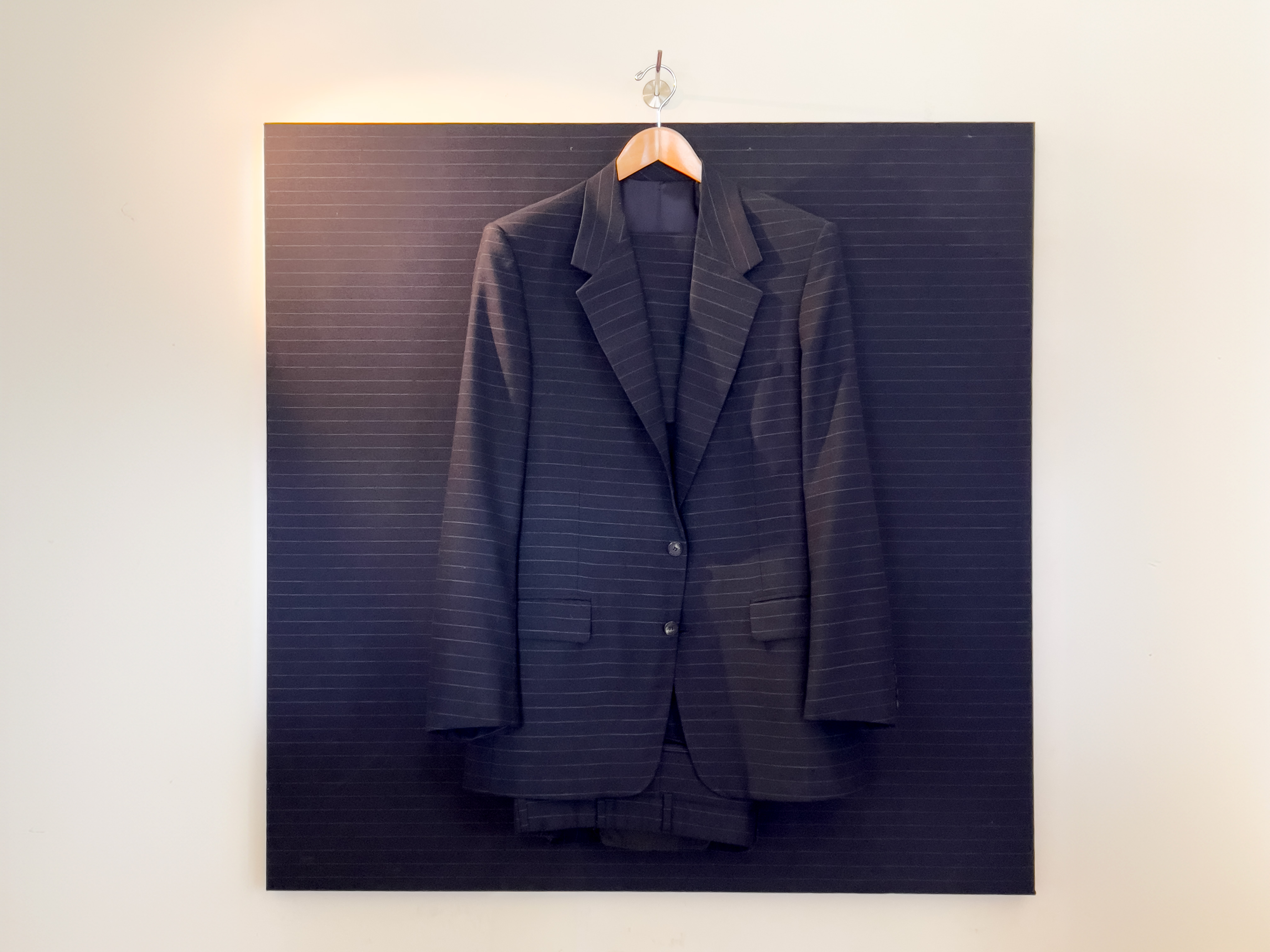
This absurdity also animates Yellow Balls, Red Tape. Created during my return to Art Center in 1986, the work arose from a renewed sense of freedom. For the first time, I felt I was making art for myself rather than fulfilling the expectations of parents, institutions, or commercial clients. The installation consisted of six four-by-eight-foot panels covered in gray headliner fabric. Each day, I attached three hundred red and yellow toy ping-pong balls to the panels with Velcro, creating new configurations that were different but always fundamentally the same. Again, action generated variation without real development. The work balanced minimalist restraint with the humor of toy-store color and tactile absurdity. My custom suit, made from the same gray fabric and worn to the opening with a Velcro ping-pong ball boutonnière, folded the artist’s body back into the work as both maker and prop.
In Take-A-Number, the absurd system is transferred to the viewer. A deli-counter ticket dispenser is encased in plexiglass, unreachable and unusable. Stanchions guide viewers toward it, asking them to participate in a ritual of waiting that cannot be fulfilled. A glowing number, 37, hovers like a bureaucratic icon, meaningful only because it marked my age at the time of the exhibition. Earlier works trapped machines or the artist inside closed loops; Take-A-Number invites the viewer into one. The result is a deadpan choreography of expectation. The line leads nowhere, but viewers recognize the ritual immediately. Its comedy depends on compliance: we know nothing will happen, yet the structure of waiting remains persuasive.
Popular Culture, Kitsch, and the Mechanization of Desire
Although my work is often conceptual, it has never been detached from popular culture. I am drawn to the strange intelligence of everyday objects, especially when they reveal unconscious social rituals of desire, display, and identity.
Competition Stripes grew out of my fascination with cars, not as machines of transportation but as aesthetic objects: lacquer, chrome, curves, decals, racing stripes, and spectacle. The work draws specifically from Knight Rider, the 1980s television show whose intelligent car, KITT, featured an oscillating red scanner light. I repurposed KITT-inspired lights into a vertical light sculpture that inevitably recalls Dan Flavin while also undercutting minimalist seriousness with automotive kitsch. The lights pulse, shimmer, and occasionally synchronize, hovering between homage and parody. The piece asks whether glowing technological spectacle belongs in the gallery, the car show, or some absurd zone between them.
Safe Sex, also known as The Sex That Peterbilt, emerged from life in downtown Los Angeles during the 1980s. Living in a converted warehouse near the flower and produce districts, surrounded by tractor trailers, I became fascinated by truck mud flaps bearing chrome silhouettes of idealized male and female bodies. These images struck me as bizarre emblems of desire: decorative, fetishistic, and strangely defensive. At the height of the AIDS epidemic, I began to think of the mud flap as a kind of prophylactic symbol, a shield that both displays and prevents contact.
The sculpture consisted of two mud flaps, one male and one female, mounted on a welded steel frame. Hidden hoses animated them with wild, erratic movement. They flailed and convulsed but never touched. The work was theatrical, funny, uneasy, and darkly tied to its historical moment. Like many of my kinetic works, it transformed motion into frustrated desire. The sculpture no longer exists, having eventually been reduced to scrap, but its disappearance seems almost appropriate. It belongs to an era of fear, sexuality, spectacle, and loss.
Value, Ownership, and the Art Economy
Questions of value and ownership have long been central to my practice. These questions appear not as abstract economic theory but as lived absurdity: artworks disappear, markets assign value arbitrarily, galleries fail, and visibility becomes a form of currency.
The digital slot machine titled Untitled transforms ownership into pure chance. A participant who lands nine consecutive zeros wins the artwork. Yet if that person later wishes to sell it, the transfer must occur through the same mechanism. The work’s value can never stabilize. It could be worth twenty-five cents or twenty-five thousand dollars. In this way, the piece literalizes the instability of art’s market value. It asks whether ownership is a legal condition, a symbolic fiction, or simply the result of a lucky sequence.
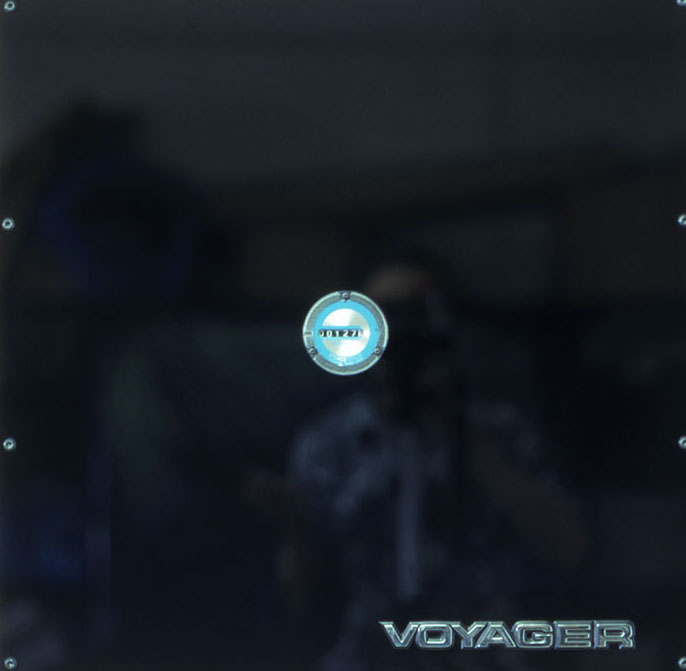
Voyager also addresses value, but through visibility. The work is a two-by-two-foot square of black plexiglass with a digital counter at its center and the word Voyager discreetly inscribed in the lower right corner. Its purpose is to record the cumulative time it has been on view. The premise is simple: if reputation, provenance, rarity, and market demand affect value, why not also exposure? How long has the artwork actually been seen?
The irony is that Voyager itself disappeared. Sent to Milli Gandini’s Night Gallery in Milan more than three decades ago, it was never returned and has not been seen since. A work designed to measure its own visibility now exists in absence. It has become, unintentionally, a perfect conceptual object: an artwork about display that has vanished from display entirely.
Plagarius was born from a related Milan debacle. My participation in the exhibition Take Over, organized through Krieger/Landau Gallery and connected to Night Gallery in Milan, was intended to address art and economics. But after a falling out between galleries, my works were held over a financial dispute and never returned. In response, I created Plagarius, an installation of missing-person-style posters and life-size silhouettes of the kidnapped artworks. The piece became a memorial, an accusation, and a joke. A show about art’s commodification had literally resulted in the disappearance of my art.
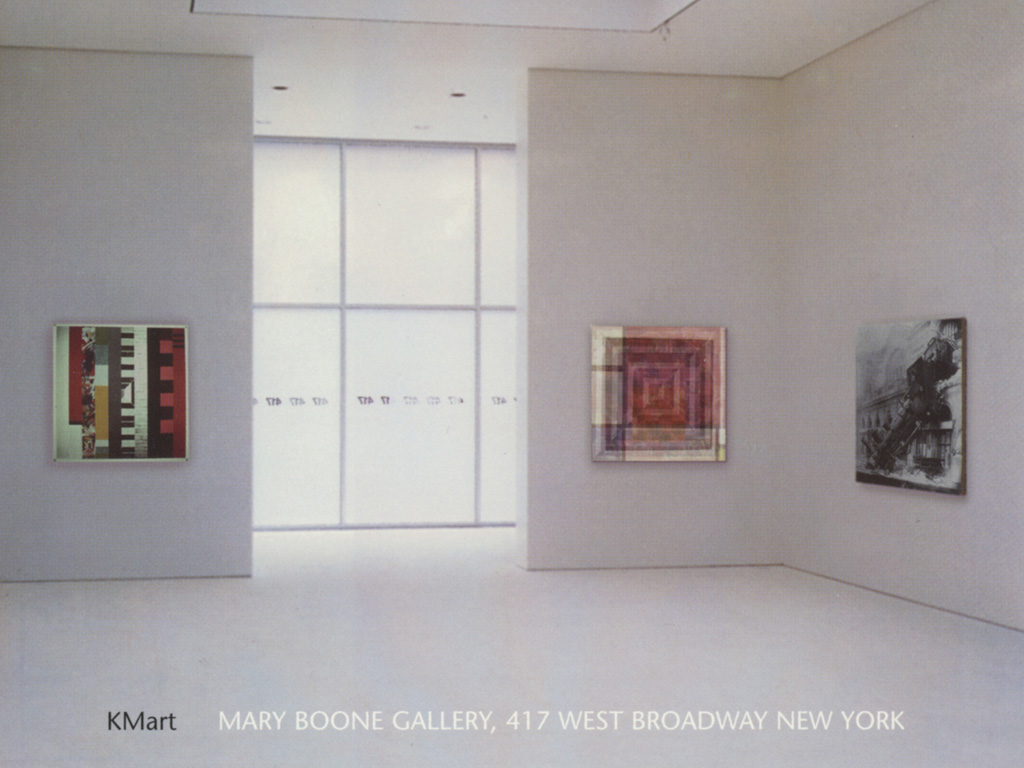
This experience also helped generate Wrecks, Accidents, & Collisions, a series of exhibition postcards for shows that never existed beyond the postcard itself. Using Photoshop in the early 1990s, I appropriated art-world images and inserted my own work into them. In one instance, I altered an Artforum advertisement for Mary Boone Gallery; in another, I inserted my work into documentation of the 1913 Armory Exhibition. These postcards functioned simultaneously as invitations, exhibitions, fictions, and acts of institutional trespass. If I no longer had a gallery, I would appropriate one. If history excluded me, I would ghost myself into it.
The Square, the Grid, and Systems of Classification
The square recurs throughout my work as both form and problem. It appears neutral, but its neutrality is deceptive. Unlike the vertical format, which evokes the body, or the horizontal format, which evokes landscape, the square often presents itself as a pure container. My work repeatedly tests that assumption.
Hollywood Square consists of a two-by-two-foot Cibachrome print made from ten canonical square paintings. Each painting is divided into ten equal sections, and the fragments are recombined chronologically, one tenth from each work contributing to a new composite image. The result is a tapestry of art historical fragments united only by format. The chronology appears rational, even scholarly, yet it also exposes the arbitrariness of art historical systems. Classification produces order, but not necessarily meaning.
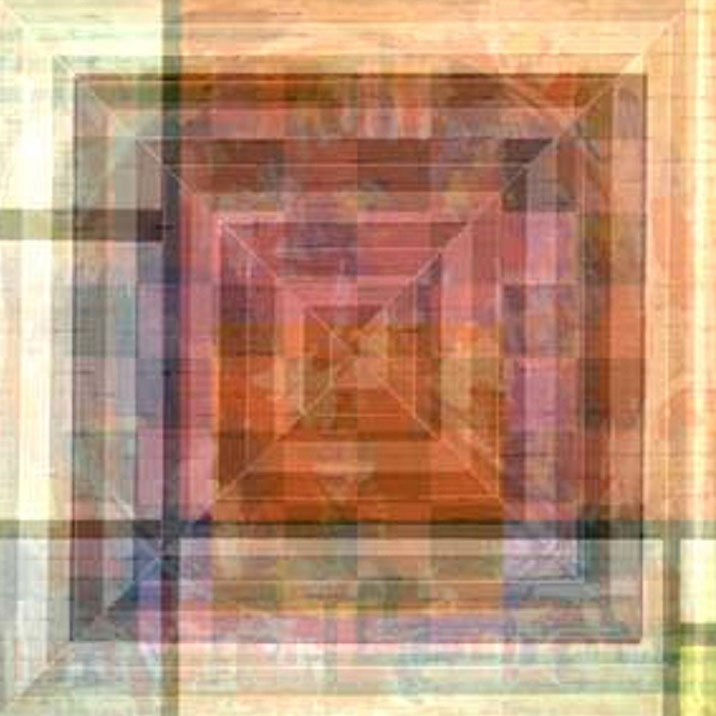
Later, when I began working with Photoshop, I revisited this logic in the Squares series. Digital layering allowed images to become translucent, reorderable, and unstable. In Square #0123456789, the ten images from Hollywood Square are layered at ten percent opacity in chronological order. In Square #9876543210, the order is reversed. A custom program generated further permutations. These works revealed how sequence itself changes perception. Meaning is not simply contained within images; it emerges through order, comparison, layering, and encounter.
Entropy offers a darker meditation on system and disorder. Based on a child’s sliding thumb puzzle, the work is made from a single block of wood, each tile painted black. There is no image to reassemble, no visual guide, no promise of resolution. The underside of each piece is numbered, but that hidden order can only be known through disassembly. To understand the system, one must destroy its apparent unity. The puzzle thus becomes a model of entropy: order exists, but it is inaccessible; restoration is possible, perhaps, but only through loss.
The Book, the Archive, and the Portable Exhibition
The loss of my downtown studio marked a turning point in my practice. Deprived of the physical conditions that had supported earlier work, I turned increasingly to the computer as both tool and conceptual site. The Book: An Exhibition emerged from this shift.
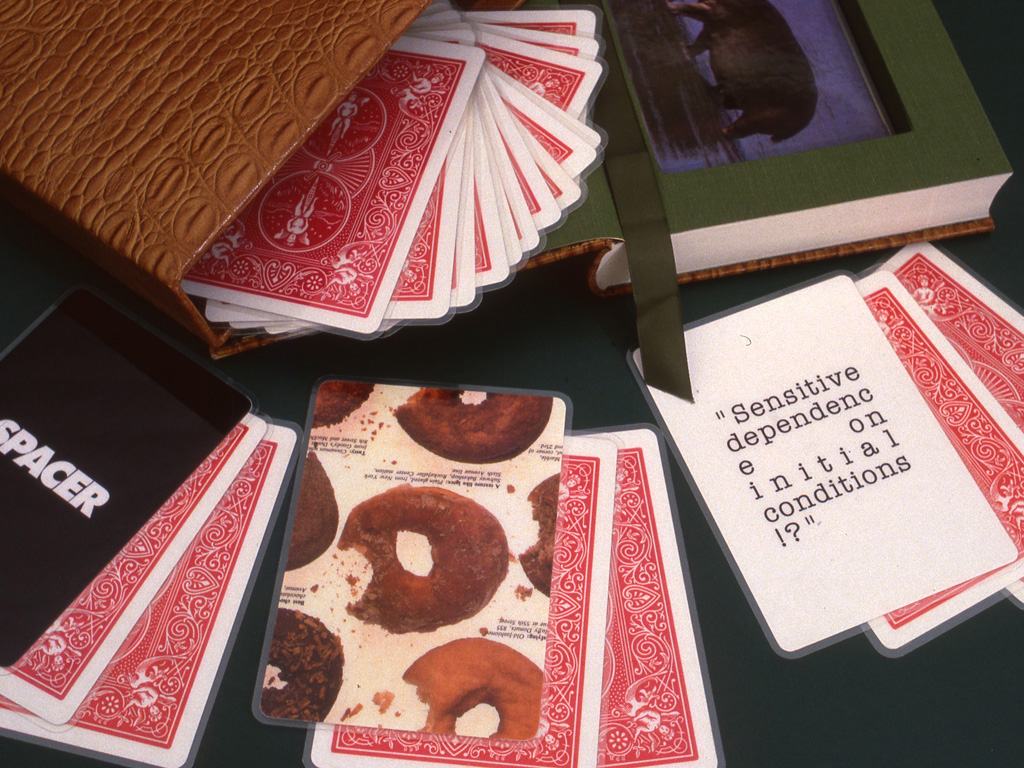
The work draws from Marcel Duchamp’s Boîte-en-valise, in which miniature reproductions of his work were housed in a portable suitcase. My version takes the form of a hollowed-out book covered in synthetic alligator skin and containing fifty-four laminated oversized playing cards. One side of each card reproduces a past work; the other retains the iconic Bicycle playing-card back. The project is simultaneously archive, game, exhibition, and cipher.
Many of the works reproduced in The Book no longer exist. Some were lost, destroyed, or stolen. The project therefore became an elegiac archive, a portable memorial to a dispersed body of work. Its playing-card structure also introduced concealment and misdirection. The deck is marked, but its logic is not immediately legible. Order is present, but hidden. In 2015, when one of the cards was stolen during an exhibition, the work’s themes of loss, containment, and control were ironically reenacted.
Digital Identity, Code, and the Image as Data
As computers became central to my practice, I became increasingly interested in the invisible systems that make images possible. Digital images appear immediate, but they depend on code, compression, protocols, and translation.
monaLisa.jpg (C++) addresses this hidden infrastructure by reimagining Leonardo da Vinci’s Mona Lisa not as an image but as the code that allows images to be interpreted and displayed. Scaled to the dimensions of Leonardo’s original and framed in reference to the Renaissance artifact, the work collapses painting into programming. The iconic image becomes both present and absent, replaced by the language of its digital mediation. It asks what is lost when an image becomes data, and what kind of aura survives compression.
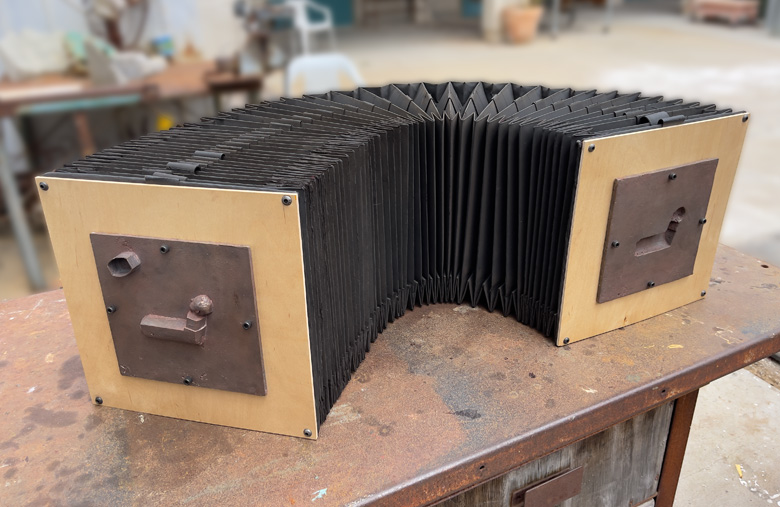
What’s In A Name extends this inquiry into identity. Searching “Kirk Miller” online produced hundreds of images of people who shared my name but not my life. I collected these digital doubles and arranged them in Photoshop according to their algorithmic order, printing the resulting grid on canvas and mounting it on a window blind mechanism so that it could expand or contract as new versions of “Kirk Miller” appeared. The work treats identity not as essence but as aggregation. Online, the self becomes a search result, a crowd of namesakes, a database accident.
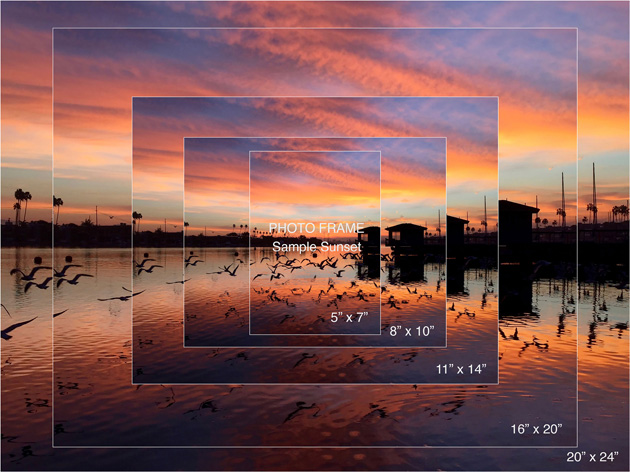
Sunrises / Sunsets turns toward the smartphone and the archive of the sublime. For years I photographed sunsets and rare sunrises during walks at the beach. The act began as an attempt to be present, yet the phone inevitably intervened. Awe became data. The infinite sky became a digital file. In later iterations, I reversed the hierarchy by foregrounding metadata—dates, file types, print parameters—while reducing the image itself to a postcard-sized afterthought. The romantic spectacle becomes an index. The sky remains vast, but the archive domesticates it.
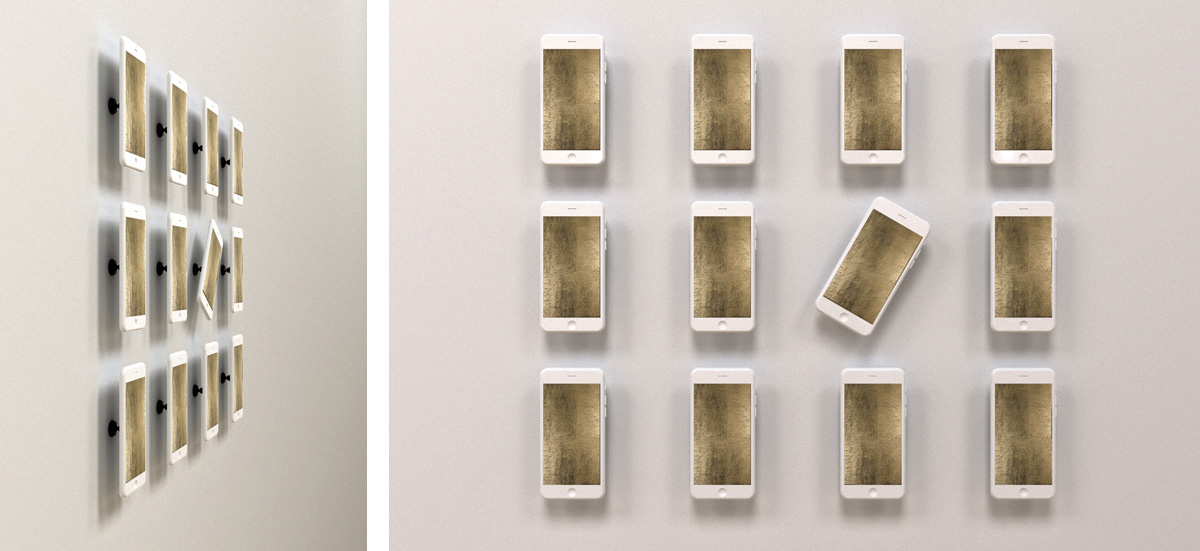
Don’t Look Directly Into the Sun continues this critique of technological mediation. The work consists of 3D-printed smartphones whose screens are covered in gold leaf. They do not function as phones; they are shells, relics, ready-mades of ready-mades. Mounted on swiveling brackets, they pivot like solar panels or devotional icons, seeking light. Gold, once reserved for sacred images, now sanctifies the empty screen. The work asks whether the smartphone has replaced the sun as an object of daily devotion. Function is stripped away, leaving only reflection, form, and ritual.
Memory, Prosthesis, and Inherited Histories
Memory in my work is never linear. It is assembled, borrowed, revised, and sometimes fabricated. Alison Landsberg’s concept of “prosthetic memory”—memories acquired through cultural artifacts rather than direct experience—has helped me articulate a central aspect of my practice. We are shaped not only by what we have lived, but by images, stories, films, objects, and histories we inherit.
This framework casts Wrecks, Accidents, & Collisions in a different light. By inserting myself into Mary Boone Gallery advertisements or the Armory Exhibition, I was not simply parodying art history. I was creating prosthetic memories: impossible but persuasive images of participation in histories I had not lived. These altered documents blur fact and fiction, allowing both artist and viewer to inhabit alternative narratives.
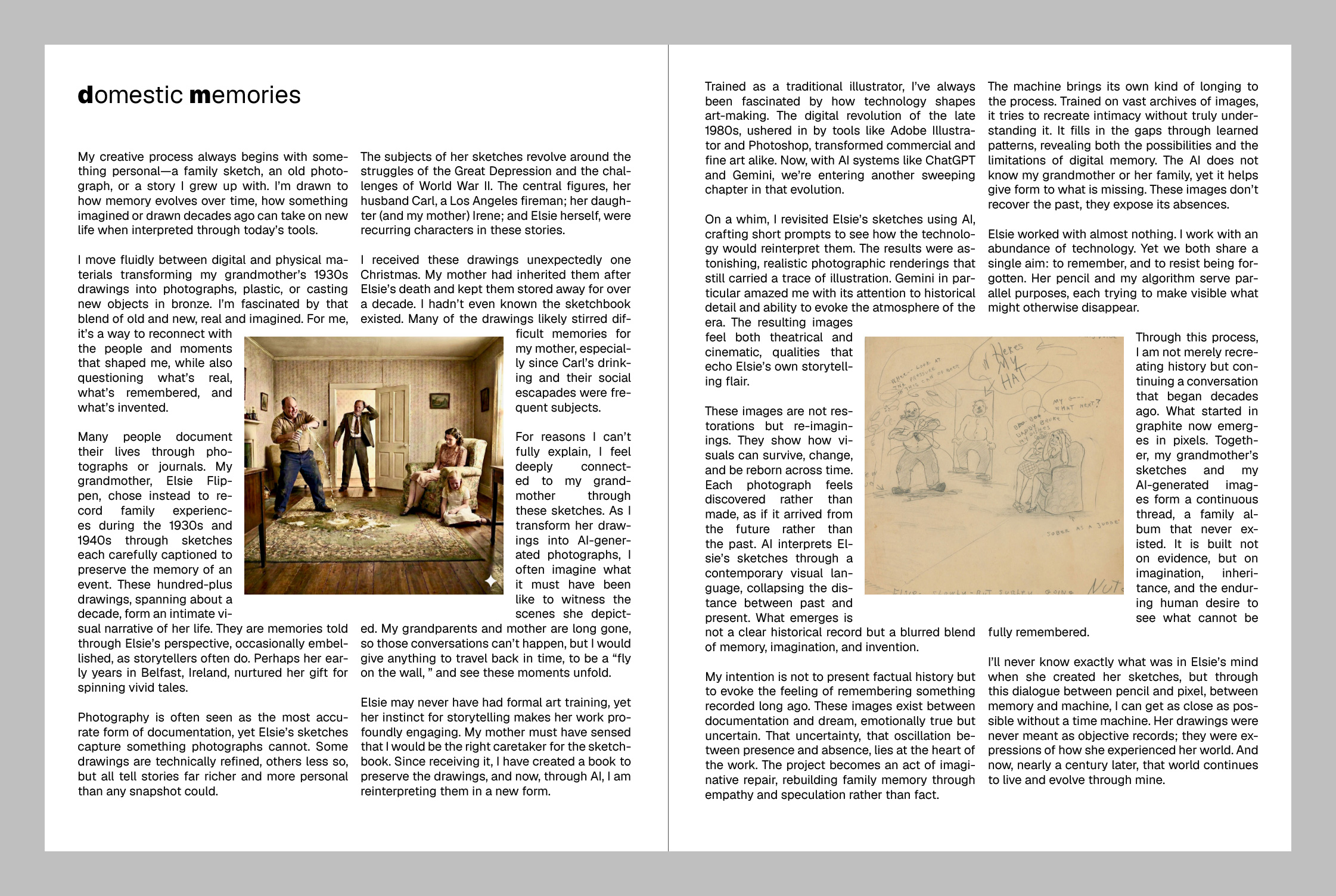
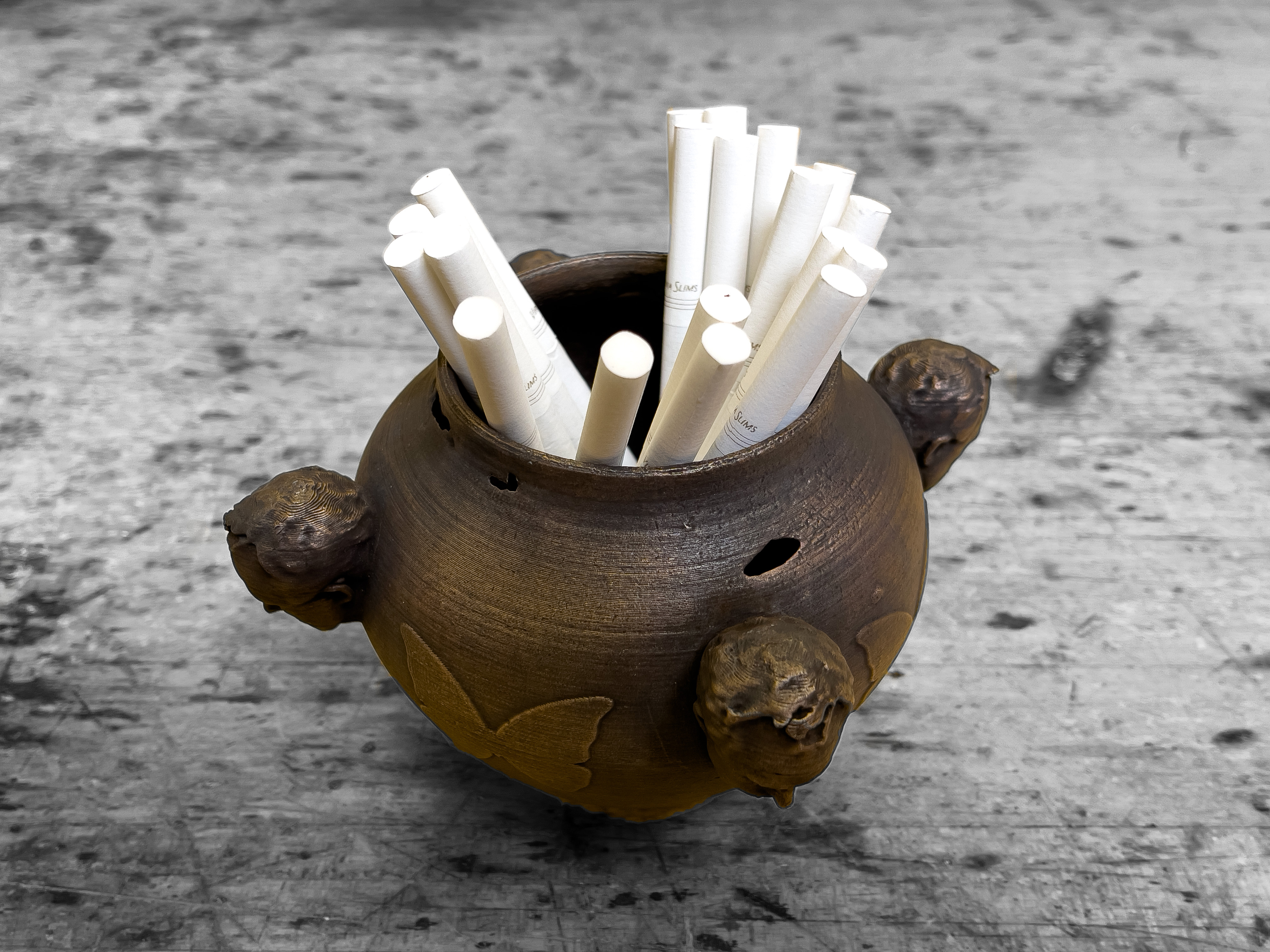
The inherited Zuni Frog Pot from my grandmother offers a more intimate version of the same condition. She emigrated from Ireland to Gallup, New Mexico, and filled my childhood with stories of Navajo and Zuni life. The pot is simultaneously hers, mine, and connected to a culture I did not directly know. It becomes a vessel of layered memory. In works such as Ubuntu and Stitching Prosthetic Memories, memory is treated not as a stable archive but as material to be stitched, unstitched, and restitched.
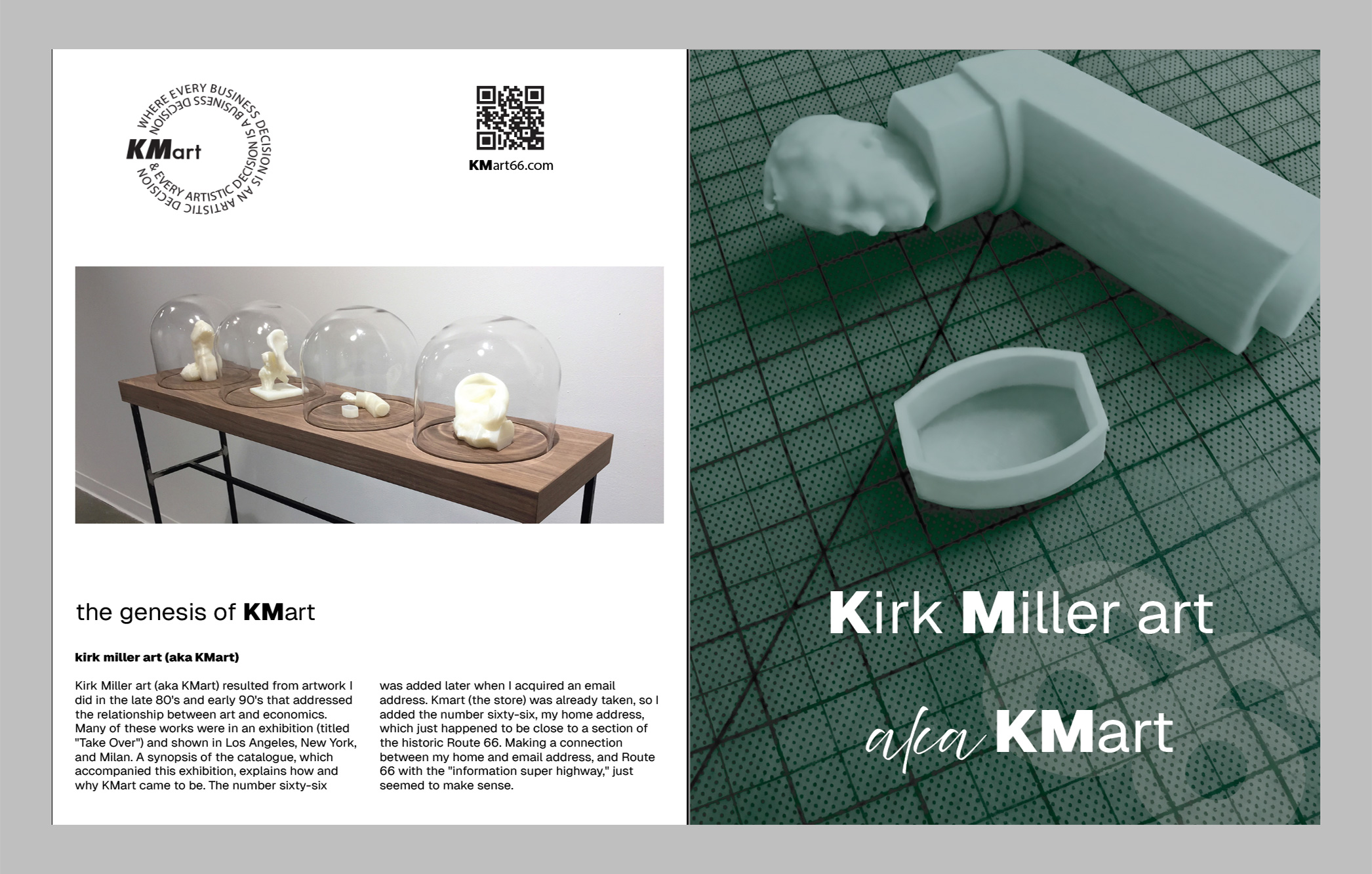
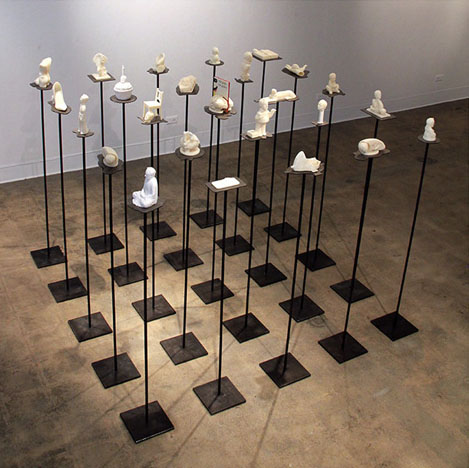
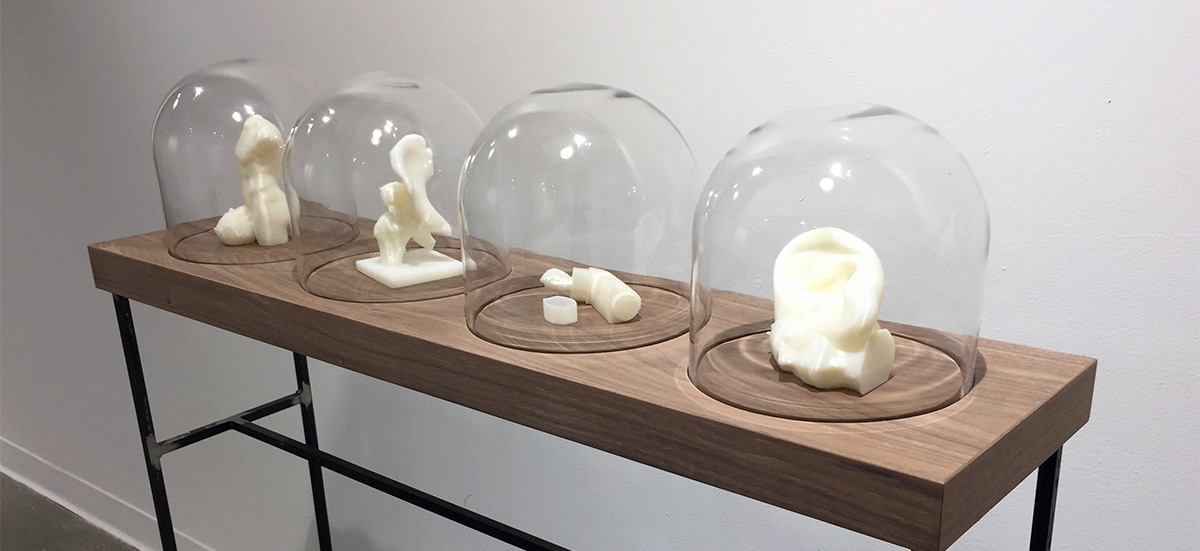
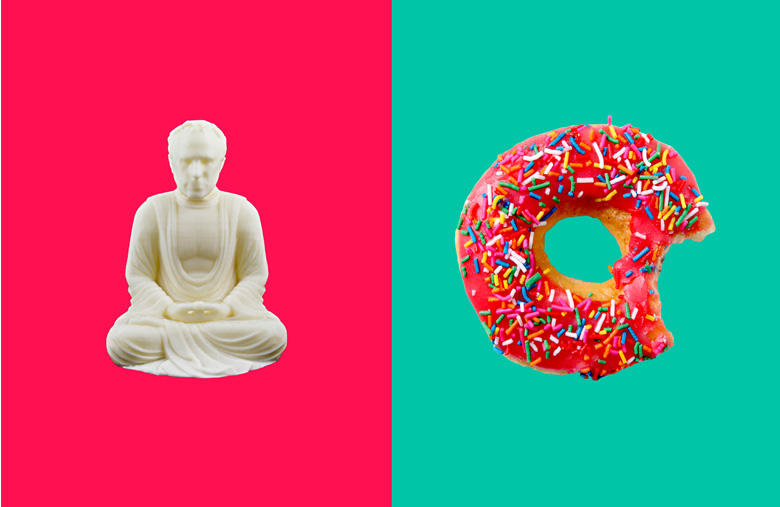
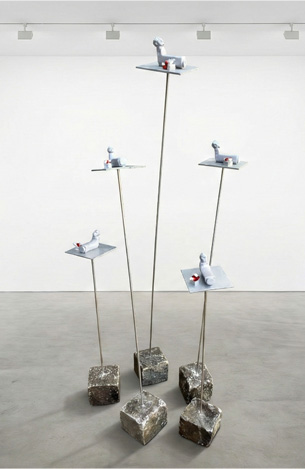
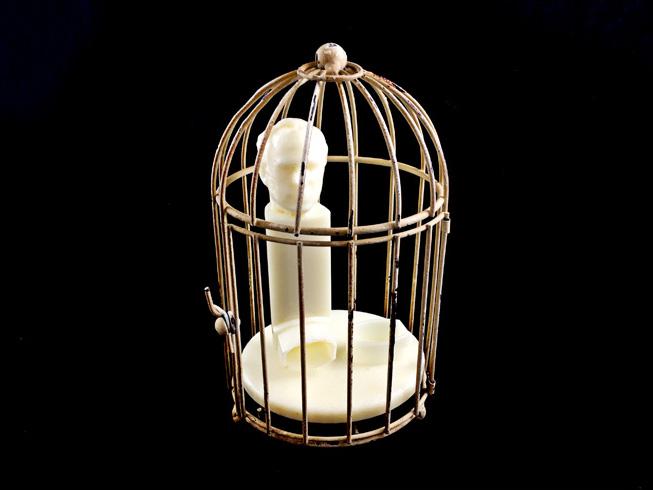
The 3D-printed Selfies embody this same instability. They do not present the self as fixed likeness but as assemblage: personal fragments, cultural references, inherited histories, and possible futures compressed into form. The related Ancillary Images serve as parallel mediators, pairing the white 3D-modeled forms with source images or conceptual referents. Inspired in part by Sarah Charlesworth’s strategies of juxtaposition, these works do not explain the selfies so much as open alternate points of entry. They create a space between object and referent, abstraction and recognition.
Body, Illness, and the Self as Reconstruction
The self in my work is not only cultural or digital; it is also bodily. Illness, asthma, cancer, hearing loss, surgery, stroke, and recovery have all shaped my sense of identity and my artistic language.
Cancer Self Portrait recounts a period of cascading medical crises: tinnitus, a broken hip, osteoporosis from corticosteroid use, a rare cancer, radiation, an acoustic neuroma, a ten-hour surgery, a stroke, and years of relearning how to walk, write, and draw. This experience reframed my life and practice. Survival was not heroic; it was incremental. It unfolded through daily negotiations with pain, fatigue, and frustration. The work locates selfhood not in continuity but in reconstruction.
Asthma has been an even longer companion. In Blades of Grass, I reflect on how asthma shaped my childhood, my introversion, and my artistic attention. Smoke, pollen, cut grass, and inhalers became both threats and motifs. The inhaler, in particular, recurs as a self-portrait object: a tool of survival transformed into sculptural identity.
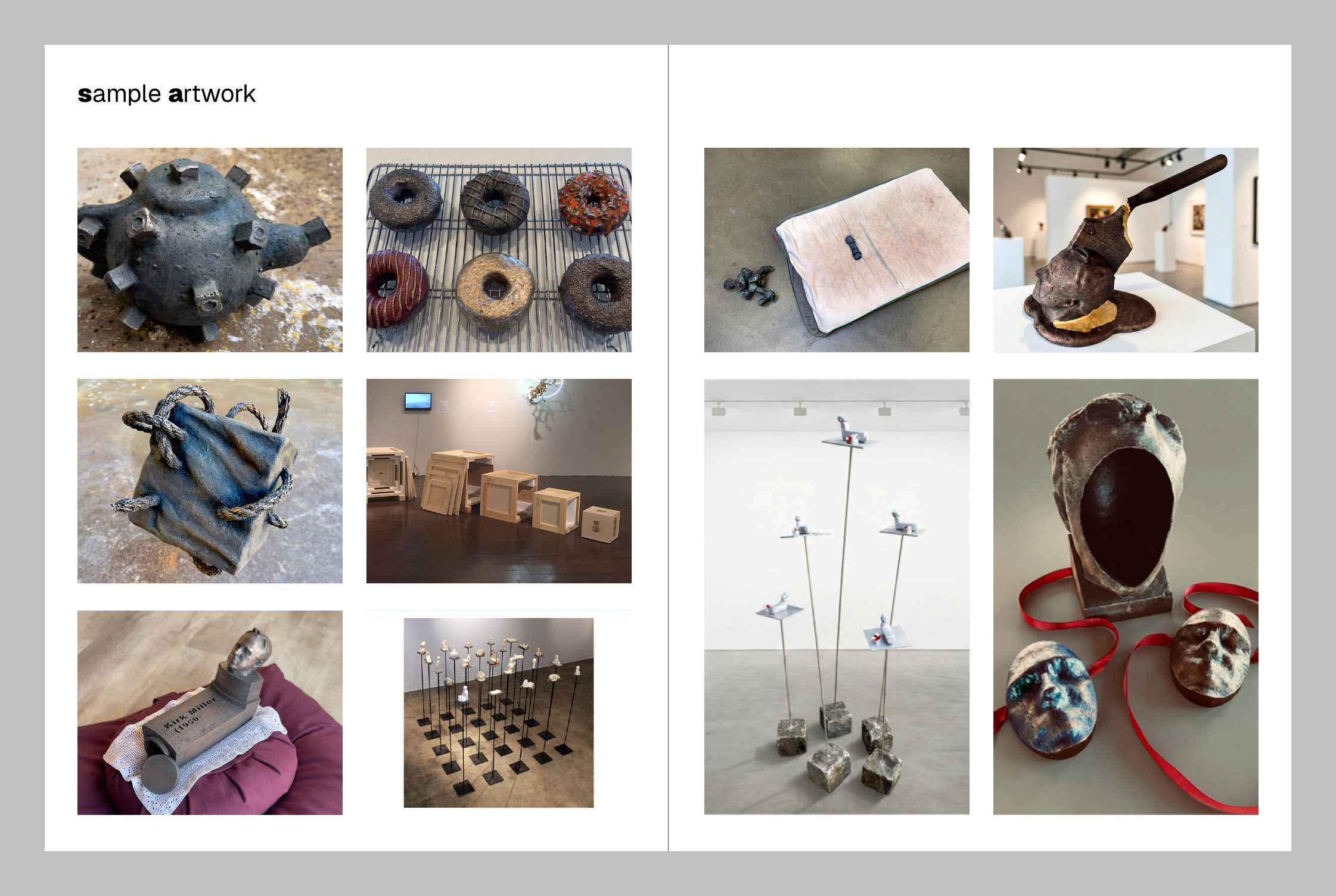
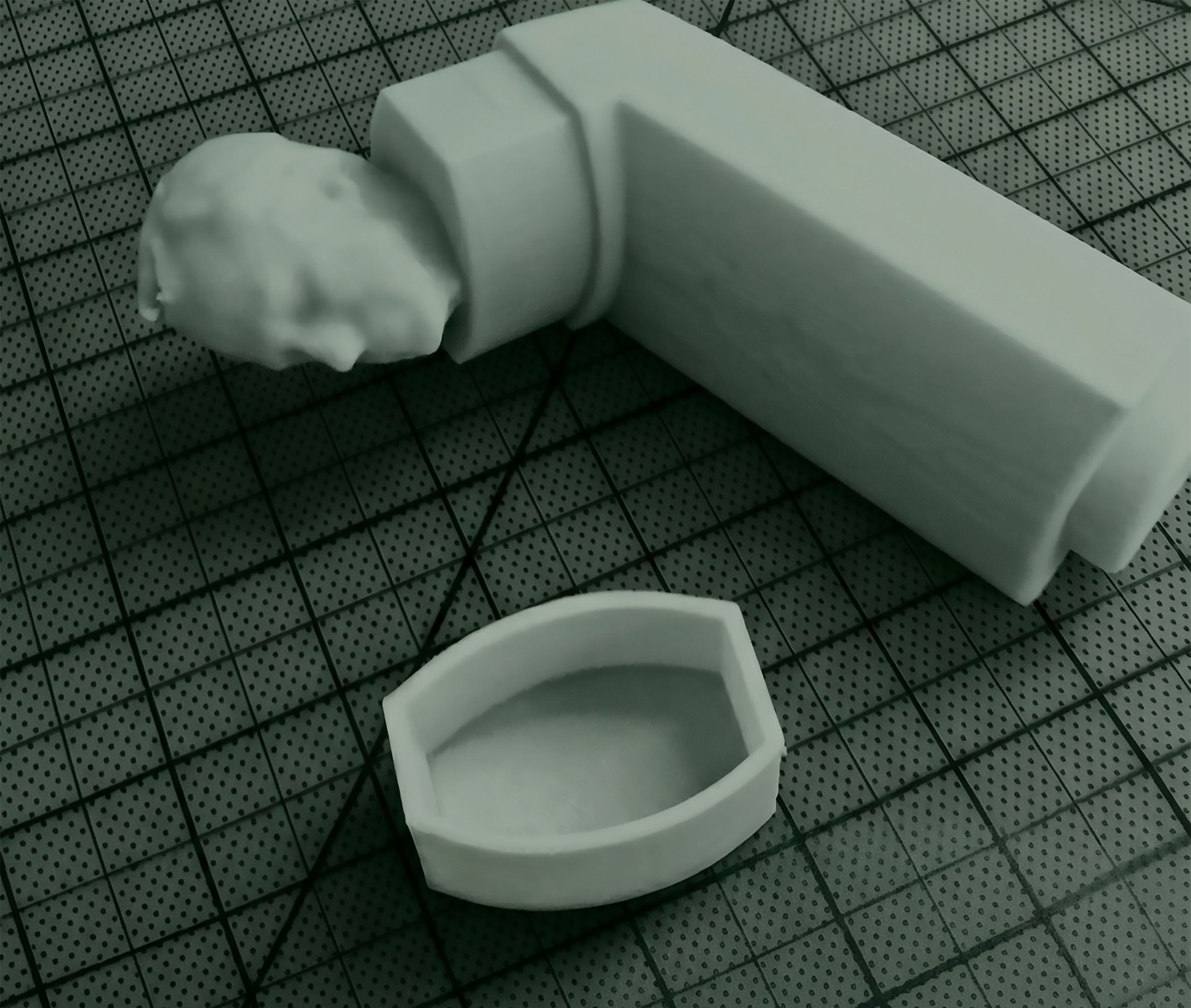
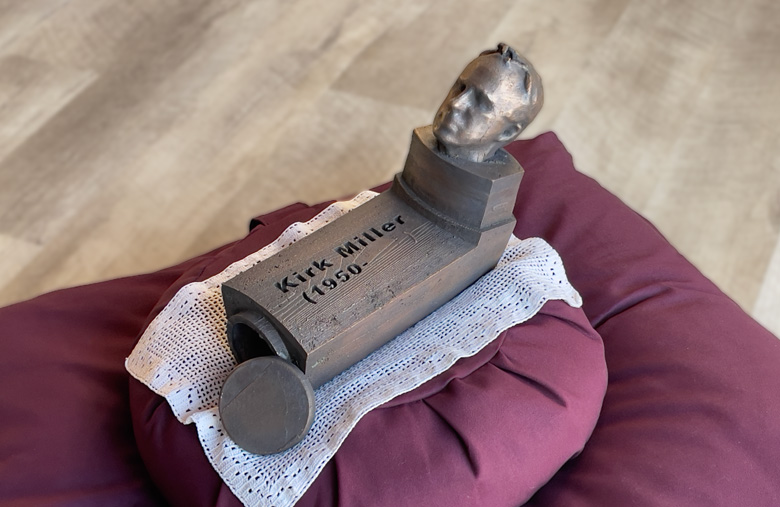
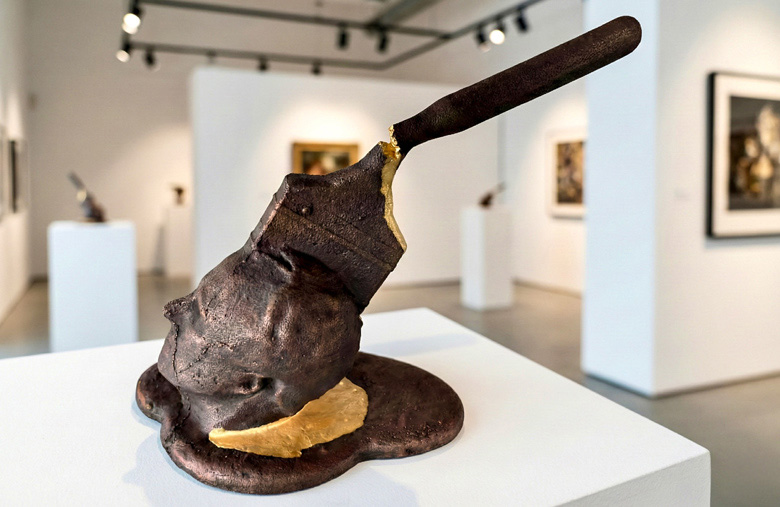
This motif culminates in He Did The Best He Could With What He Had, a bronze funerary urn in the form of an inhaler topped with my own head. Intended eventually to hold my ashes, it currently sits beneath the hearth on a zafu and zabuton, waiting in meditation. The urn is absurd, tender, and mortal. It already contains me conceptually before it contains me physically.
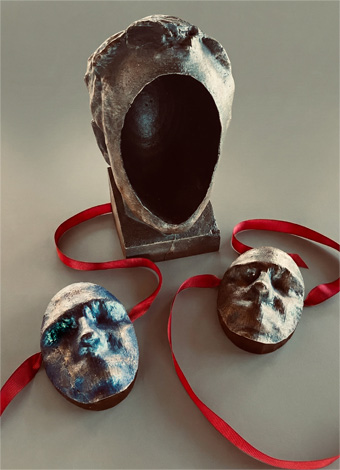
Empty Head further dismantles portraiture. A hollow bronze shell replaces likeness with absence, while a detached mask lies beside it. The work turns portraiture inside out. Identity appears as role, costume, and void. Drawing on Zen notions of no-self and Derrida’s attention to absence, the piece suggests that the true self may not be found through accumulation but through subtraction.
Objects of Comfort, Threat, and Absurd Memory
Memory often attaches itself to ordinary objects. In my work, these objects are rarely left intact. They become altered, weaponized, or made absurd.
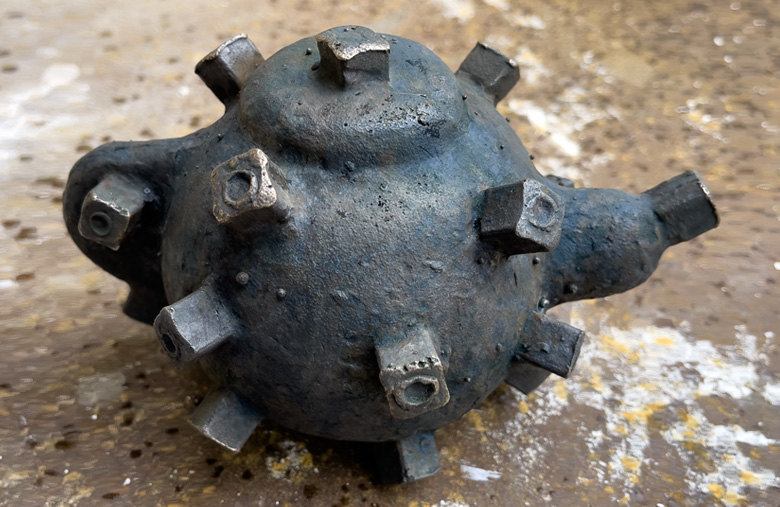
Absurd Teapot & Cup returns to childhood asthma, when my mother and grandmother offered hot tea as comfort during attacks. In bronze, the teapot and cup become tributes to that ritual, but filtered through absurdity. The teacup sprouts spikes, making it impossible to hold. The teapot bristles with the detonator horns of a World War II naval mine. Objects of solace become objects of danger. Comfort and threat coexist.
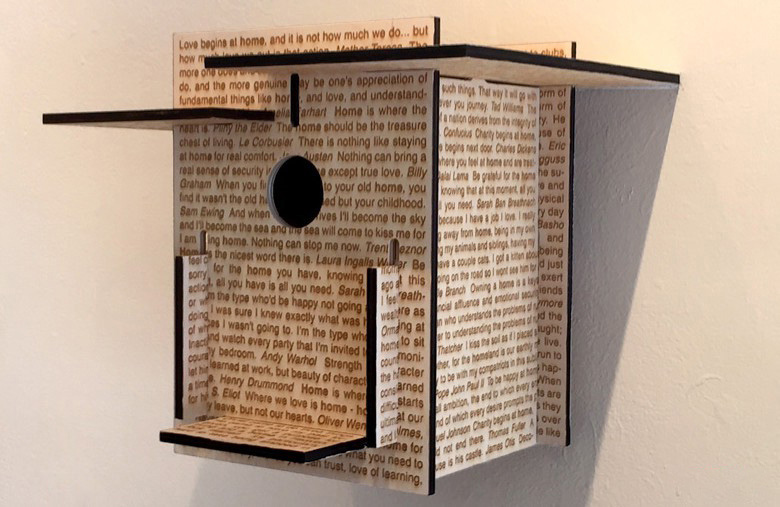
Untitled (Home) began as a prompt to create a unique birdhouse. Initially dismissing the project as trivial, I eventually reframed the birdhouse as a meditation on home. I gathered quotations about home from the internet and laser-etched them across the object, inside and out. The birdhouse became an archive of language, a dwelling made from words. What seemed like a minor assignment opened into a broader inquiry into belonging, memory, refuge, and place.
No-Thing-Ness, Emptiness, and Sacred Space
Over time, my engagement with nothingness shifted. The early absurd works treated emptiness as futility, stasis, or negation. More recent works approach no-thing-ness as possibility.
The torus became an important form in this transition. As a donut shape, it is both banal and profound: a pastry, a pool float, a mathematical object, a topology, a cosmic model, and a primitive form in 3D modeling software. It is a zero with volume, a loop around absence. In Fur Torus, the form is cloaked in fur, recalling Meret Oppenheim’s fur-lined teacup while transforming the digital primitive into something tactile, absurd, and uncanny. The torus becomes a symbol of nothingness that can almost be touched.
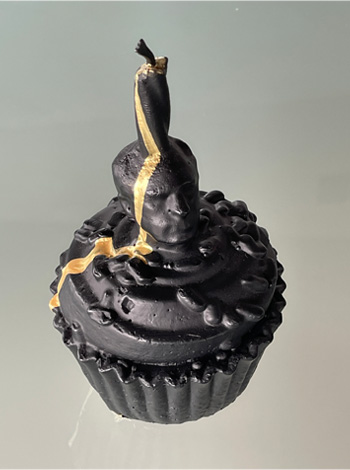
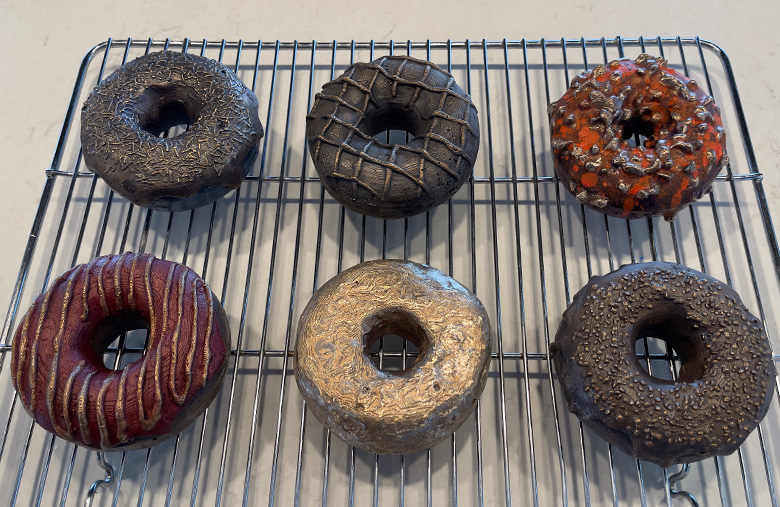
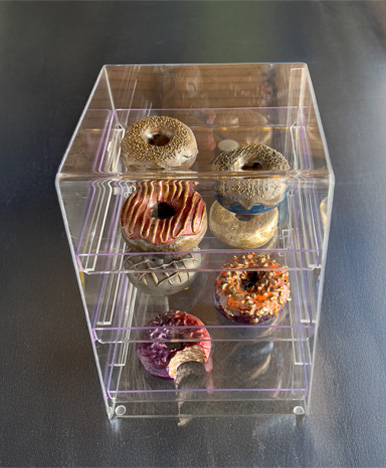
Six of One. A Half Dozen of Another extends the torus into bronze and into the language of desire. The donut suggests emptiness, indulgence, sugar, and lack. Drawing on Kara Walker’s observation that sugar has long been tied to desire, the work treats the donut as a sweetened zero, a form of visual pleasure that is full of emptiness and empty fullness.
Are You Pouring, Or Am I Drinking?, also known as Half, shifts from absurdist negation toward relational presence. A wine glass is neither half-empty nor half-full; it is simply half, caught in a state of becoming. The question in the title refuses resolution. Meaning arises not from the object alone but from the exchange between giver and receiver, pourer and drinker. The work resists binary thinking and invites viewers into the in-between.
Light & Air takes this idea further. A bare corner of a room becomes sacred space, not because of architecture, ornament, or religious designation, but because presence itself is sacred. Influenced by Zazen meditation, the work proposes that sacredness is not where one goes but where one is. The overlooked corner becomes a locus of attention, humility, and being.
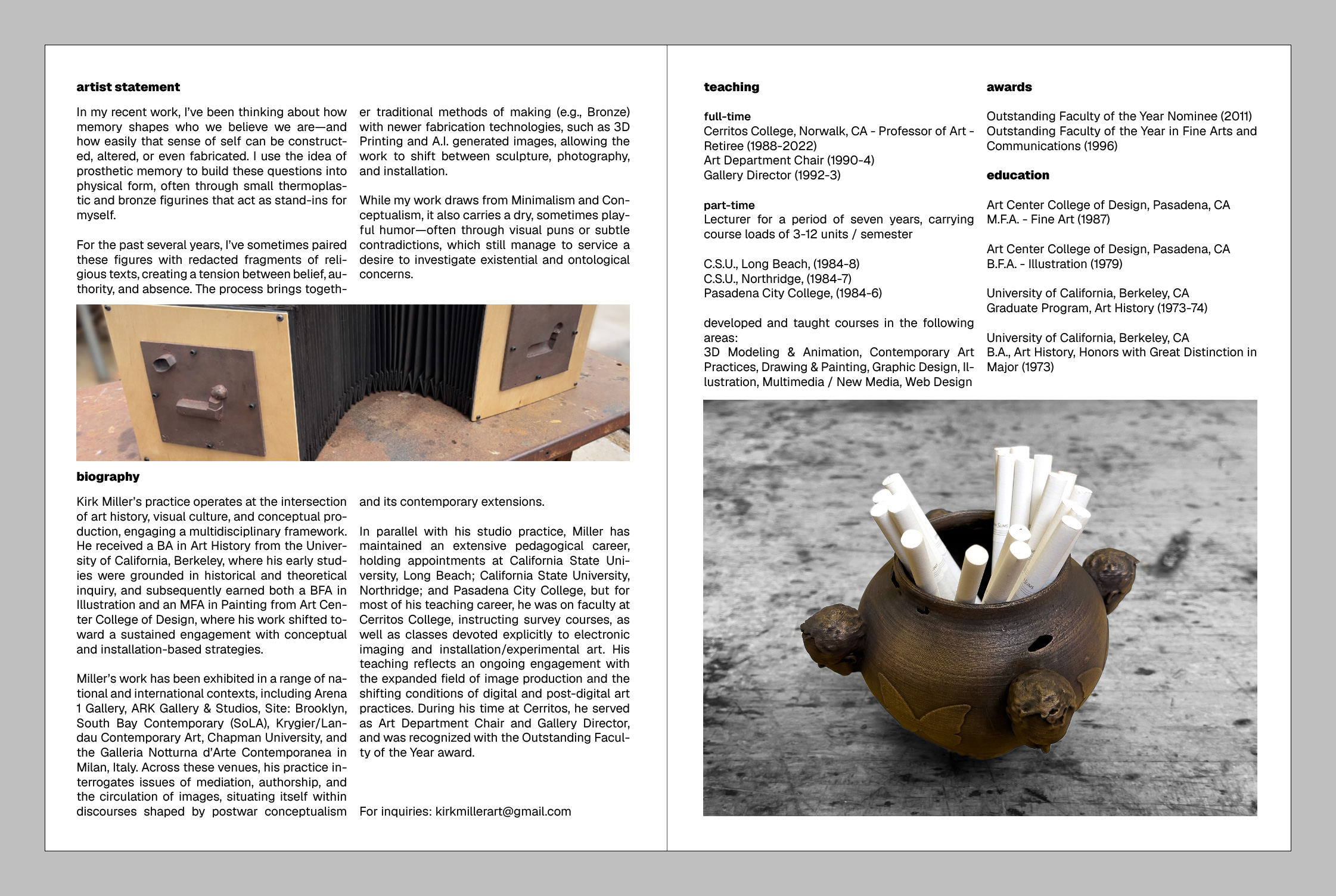
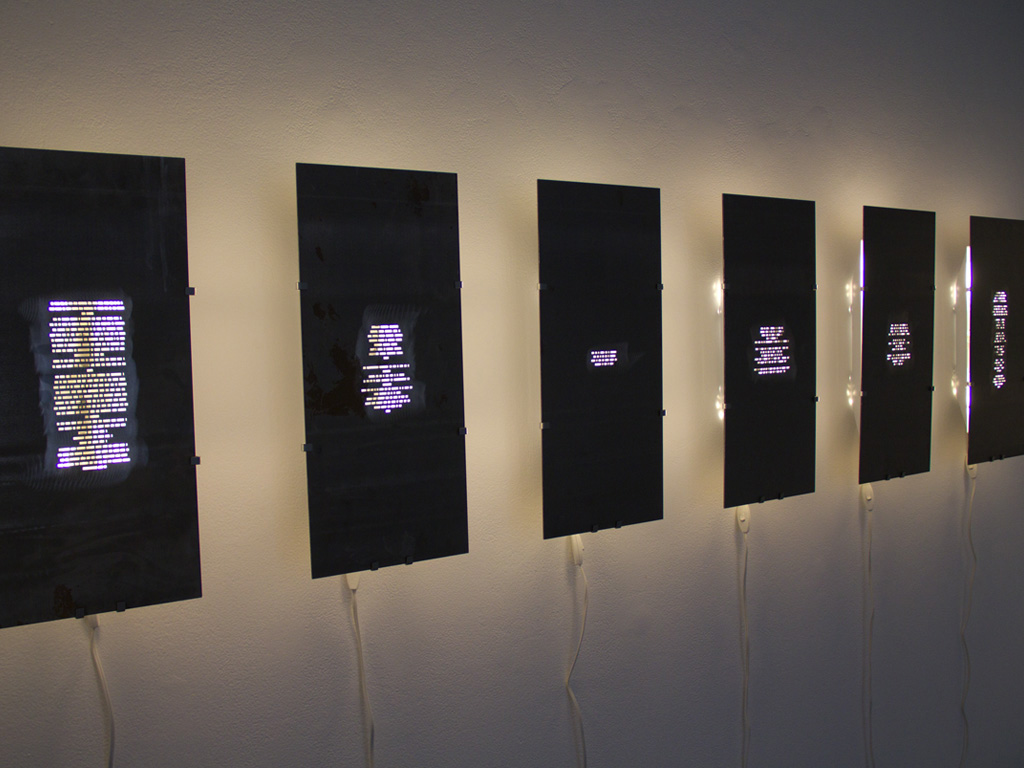
SacredTextSacredSpace makes absence visible through the erasure of sacred texts from six major traditions: Buddhism, Christianity, Hinduism, Islam, Judaism, and Taoism. Plasma-cut or laser-cut panels remove language, leaving holes through which light radiates. The deletion of words does not destroy meaning; it opens another kind of perception. Language recedes, and form, energy, and light come forward.
The Present (A Gift) and SacredTextSacredSpace IV pursue this through paper and bronze, using texts from Judaism and Taoism that are meticulously excised. What remains is not emptiness as lack but absence as offering. The void becomes a gift.
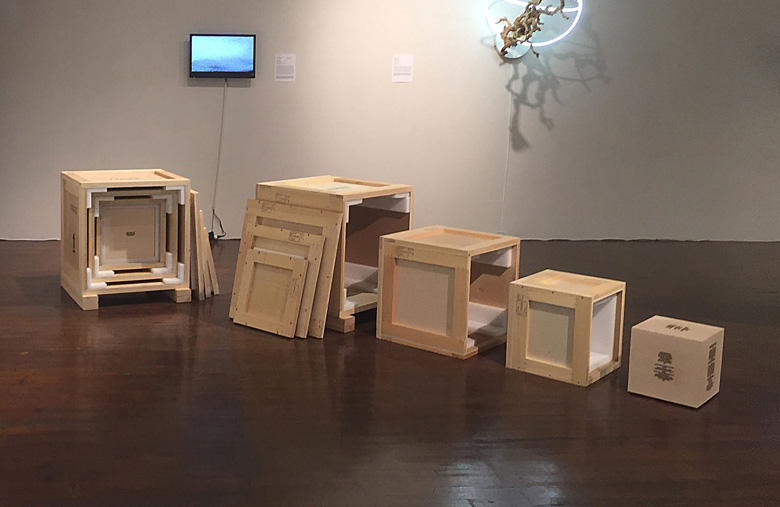
Fragile complicates this field through nested crates that sit somewhere between Pandora’s box, coffin, artwork, and frame. The work invokes Derrida’s parergon, the unstable boundary between the artwork and what surrounds or supports it. Inside the boxes are a core cube with redacted religious text fragments and dice bearing arbitrary I Ching charts. Chance and change become nearly indistinguishable. The sacred, the random, the framed, and the fragile converge.
The SPACER pieces translate emptiness into exhibition structure. Inspired by Debussy’s remark that music is the space between the notes, Miles Davis’ attention to the notes not played, and John Cage’s insistence that there is no such thing as silence, these works occupy the intervals between other artworks. They do not compete for attention; they reframe attention. Like rests in music, they make the surrounding experience legible.
Nature, Simulation, and Technological Permanence
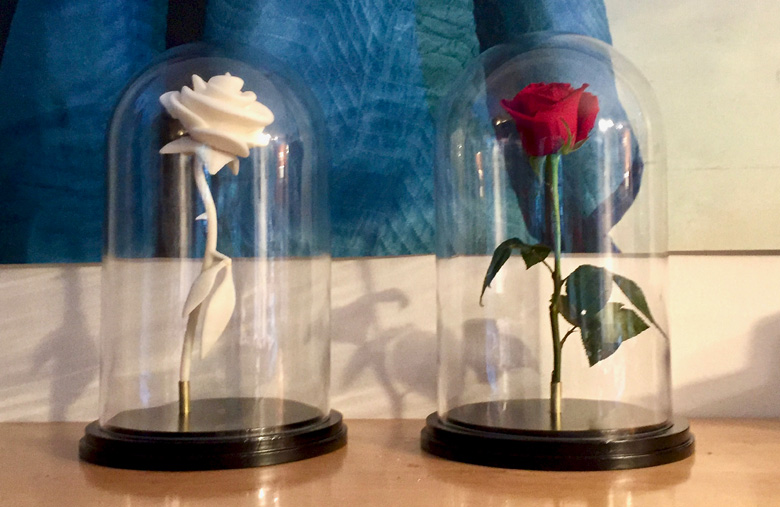
Recent works also explore the tension between nature and technological simulation. War of the Roses stages a confrontation between a living red rose and a flawless white 3D-printed rose, each placed beneath a glass dome. The red rose is alive but doomed; the white rose is perfect but lifeless. One changes, decays, and carries scent; the other endures without history. The glass dome protects and imprisons, preserving visibility while controlling breath.
The work inevitably speaks to artificial intelligence and the broader cultural condition of seamless simulation. If imitation can outlast the original, what becomes of authenticity? Is permanence more valuable than life? Does preservation protect, or does it smother? The living rose loses, but only if survival is the measure. If beauty includes change, fragility, and mortality, then the red rose retains something the white rose cannot imitate.
Virtual Space and the Exhibition Without Limits
My Virtual Virtual arose during the pandemic, while I was teaching remotely on Zoom at the end of my academic career. Facing the question of what my final faculty exhibition might be, I created a virtual exhibition using my skills in 3D computer modeling and animation. The works were digital renderings of actual pieces, some reimagined as they might ideally be displayed. Monumental wooden elephant selfies entered into dialogue with Paul McCarthy’s subversive Disney sculptures; an oversized chrome chair nodded to Robert Therrien’s monumental furniture.
Although lockdown prevented a traditional exhibition, the virtual format offered another kind of freedom. It allowed me to construct a space unconstrained by budgets, architecture, shipping, scale, or institutional permission. It was not an escape from material practice but an expansion of it. The virtual gallery became both retrospective and speculative: an exhibition of what had been, what might have been, and what could still be imagined.
In Summary: The Work Between Presence and Absence
Across these works, certain questions persist. What is value? Who assigns it? What is ownership? What is identity? How does memory become art, and how does art become memory? What happens when systems continue to function after their meaning has collapsed? What remains when language is removed, when images become code, when the self becomes a shell, when a sacred text becomes light, when a rose becomes plastic, when a gallery becomes virtual, when an artwork vanishes?
My practice is eclectic because the questions themselves are not confined to one medium. Minimalism, Conceptualism, popular culture, absurdist theater, digital technology, Zen meditation, autobiography, illness, and humor all coexist because they are part of the same inquiry. The work moves between the deadpan and the sacred, between joke and elegy, between critique and wonder.
If the early works insist that human systems are absurd, the later works suggest that absurdity is not the final word. The void is not only an endpoint. It can also be an opening. Nothingness can be futile, but it can also be fertile. It can be the silence between notes, the empty corner filled with light and air, the redacted text through which illumination passes, the hollow head that refuses likeness, the missing artwork that becomes legend, the half glass that resists easy interpretation.
In the end, my work does not resolve these contradictions. It inhabits them. It asks viewers to stand in the line that leads nowhere, listen to the spring snap again, watch the square rotate, consider the missing piece, search for the self among strangers, and notice the space between things. Somewhere in that interval—between motion and stasis, humor and dread, absence and presence—meaning appears, disappears, and begins again.